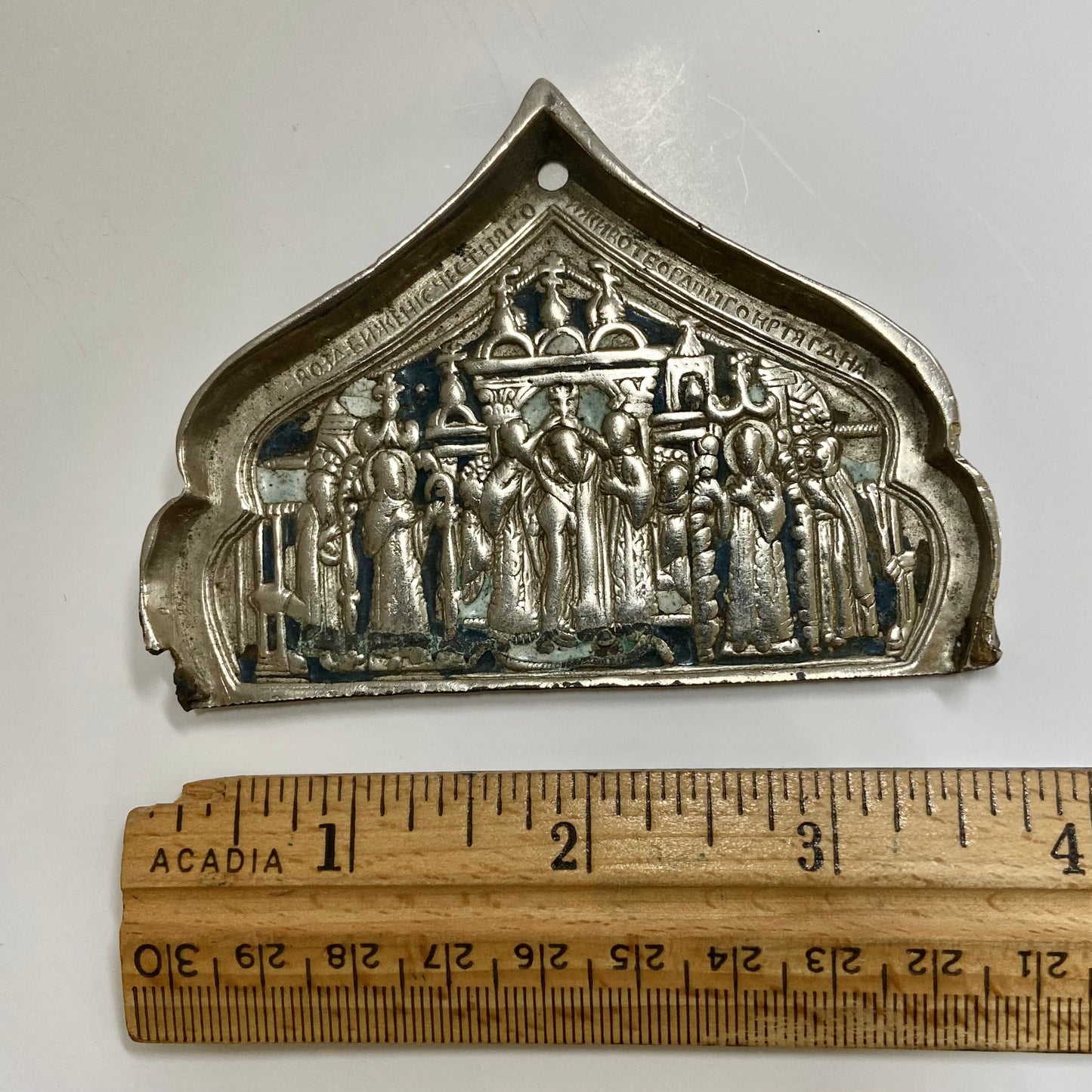
This ogee-arch crest with blue enamel inlay shows the "Exaltation (Vozdvizhenie) of the Cross with SS Constantine and Helen." It would have been at the top of the third leaf of a travel icon that was attached by piano hinges so the leaves close over one another from both ends: the two outer backs have an Orthodox design. When folded the third leaf has an engraving on the reverse: represented is the Golgotha Cross with Slavonic orthography and floral work.
The inscription reads "Vozdvizhenie Chestnago I Zhivotvoryashchago Kresta Gospoda Nashego Isusa Khrista."
Saint Helen, the mother of Saint Constantine the Great, found three crosses at the Lord's tomb in Golgotha in the 3rd century, knowing the True Cross was among them. The True Cross is lifted and exalted during the Great Feast surrounded by clergy and SS Constantine and Helen.
Metal travel icons were mostly used by the Old Believers--a sect of Russian Orthodox Christians who left the main church because of reforms by patriarch Nikon in the 1650s. They were persecuted and fled to the wilderness where they started their own monasteries. In 1723, Peter the Great banned the casting of metal icons, but they continued to be made.
Early icons were worn around the neck, fastened to the gates of houses or grave crosses, wrapped in cloth and were put in graves. The icons depicting patron saints were often given to soldiers and travelers for protection.
Type: Russian Orthodox Ogee-Arch (Kokoshnik) Crest; Third Leaf Crest with engraving on reverse Age: 18th Century Locality: Eastern Europe/Russia Material: Cast Brass